
 By
By 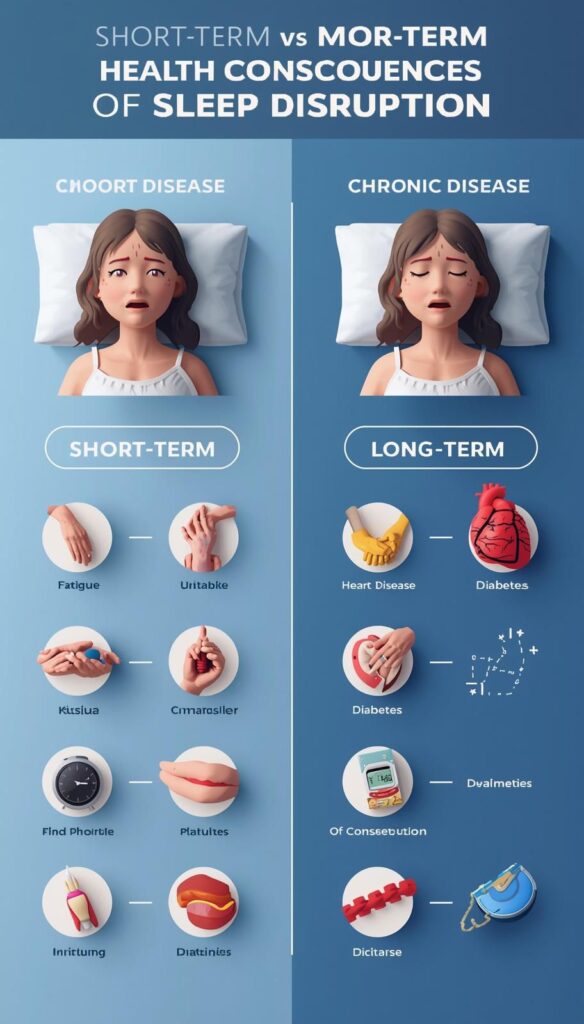
Sleep plays a vital role in brain function and systemic physiology across many body systems. Problems with sleep are widely prevalent and include deficits in quantity and quality of sleep; sleep problems that impact the continuity of sleep are collectively referred to as sleep disruptions. Numerous factors contribute to sleep disruption, ranging from lifestyle and environmental factors to sleep disorders and other medical conditions. Sleep disruptions have substantial adverse short- and long-term health consequences. A literature search was conducted to provide a nonsystematic review of these health consequences (this review was designed to be nonsystematic to better focus on the topics of interest due to the myriad parameters affected by sleep). Sleep disruption is associated with increased activity of the sympathetic nervous system and hypothalamic–pituitary–adrenal axis, metabolic effects, changes in circadian rhythms, and proinflammatory responses. In otherwise healthy adults, short-term consequences of sleep disruption include increased stress responsivity, somatic pain, reduced quality of life, emotional distress and mood disorders, and cognitive, memory, and performance deficits. For adolescents, psychosocial health, school performance, and risk-taking behaviors are impacted by sleep disruption. Behavioral problems and cognitive functioning are associated with sleep disruption in children. Long-term consequences of sleep disruption in otherwise healthy individuals include hypertension, dyslipidemia, cardiovascular disease, weight-related issues, metabolic syndrome, type 2 diabetes mellitus, and colorectal cancer. All-cause mortality is also increased in men with sleep disturbances. For those with underlying medical conditions, sleep disruption may diminish the health-related quality of life of children and adolescents and may worsen the severity of common gastrointestinal disorders. As a result of the potential consequences of sleep disruption, health care professionals should be cognizant of how managing underlying medical conditions may help to optimize sleep continuity and consider prescribing interventions that minimize sleep disruption.
Keywords: sleep, sleep disorders, children, adolescents, adults, health status
Introduction
Sleep is a biologic process that is essential for life and optimal health. Sleep plays a critical role in brain function and systemic physiology, including metabolism, appetite regulation, and the functioning of immune, hormonal, and cardiovascular systems.1,2 Normal healthy sleep is characterized by sufficient duration, good quality, appropriate timing and regularity, and the absence of sleep disturbances and disorders.3 Despite the importance of sleep, up to 70 million people in the US and ~45 million people in Europe have a chronic sleep disorder that impacts daily functioning and health.2,4 For example, ~20% of the serious injuries that result from car accidents can be associated with driver sleepiness, independent of the effects of alcohol.2 Lifestyle and environmental factors, psychosocial issues, and medical conditions all contribute to sleep problems.2 There are ~100 sleep disorder classifications; however, they are typically manifested in one of the following three ways: failure to obtain the necessary amount or quality of sleep (sleep deprivation), an inability to maintain sleep continuity (disrupted sleep, also called sleep fragmentation, difficulty maintaining sleep, and middle insomnia), and events that occur during sleep (eg, sleep apnea, restless legs syndrome).2 The effects of sleep disorders on the body are numerous and widely varied across multiple body systems. This review focuses on the clinical consequences, both short term and long term, that result from disrupted sleep (not including short sleep duration) in adults, adolescents, and children who are otherwise healthy and in those who have an underlying medical condition. Information on basic science and mechanisms of these effects are included to provide background for the clinical outcomes, but are not thoroughly reviewed. Several recent reviews provide detailed information on the science and mechanisms of sleep disruption.5–7
Methodology
In order to better focus on the topics of interest among the myriad parameters affected by sleep, this review of the literature was designed to be nonsystematic. A search of English-language publications in the PubMed database was conducted in March and April 2016. Search terms were “caregiver AND sleep”, “caregiver AND drug administration”, “insomnia”, “middle insomnia”, “restless leg[s] syndrome”, “sleep AND drug administration”, “sleep apnea”, “sleep continuity”, “sleep deprivation”, “sleep disorder”, “sleep disruption”, “sleep disturbance”, “sleep fragmentation”, and “sleep maintenance”. Together, these search terms generated over 60,000 hits. For each individual search, we reviewed the most recent articles to identify those that specifically discussed the consequences of disrupted sleep, rather than those of short sleep duration or other sleep problems. For topics that were not adequately covered by recent literature (previous ~5–10 years), we looked slightly further back in the literature. Other publications were identified by examining the reference lists of publications included in the literature searches. The websites of the American Academy of Sleep Medicine, Sleep Research Society, and the European Sleep Research Society were also searched for additional publications. This nonsystematic review pulled information from a total of 97 references.
Characteristics of normal sleep
The stages of sleep have historically been divided into one stage of rapid eye movement (REM) sleep and four stages (Stages 1–4) of non-rapid eye movement (NREM) sleep that are characterized by increasing sleep depth.2,8 The deeper sleep stages (Stages 3 and 4) are collectively referred to as slow-wave sleep (SWS), which is believed to be the most restorative type of sleep and typically occurs during the first one-third of the night.2,8,9 In contrast, REM sleep increases as the night progresses and is longest in the last one-third of a sleep episode.2 REM and NREM sleep are characterized by numerous, yet different, physiologic changes, including brain activity, heart rate, blood pressure (BP), sympathetic nervous system activity, muscle tone, blood flow to the brain, respiration, airway resistance, renal function, endocrine function, body temperature, and sexual arousal.2 For example, during NREM sleep, heart rate, BP, blood flow to the brain, and respiration are decreased compared with wakeful periods. During REM sleep, these processes are increased compared with NREM sleep. Brain activity decreases from wakefulness during NREM sleep; activity levels are similar during REM sleep, except for increases in motor and sensory areas.2
A newer sleep classification system developed by the American Academy of Sleep Medicine has only three stages of NREM sleep: lighter sleep (Stages N1 and N2) and deeper sleep (or SWS; Stage N3).10 The major changes with the newer classification system are focused on electroencephalogram (EEG) derivations and the merging of Stages 3 and 4 into Stage N3.11 In a comparison of the two sleep classifications, only minor differences were noted for total sleep time, sleep efficiency, and REM sleep, but the choice of classification impacted the measurement of wake after sleep onset and the distribution of NREM sleep stages.11
The two-process model describes the interplay between the sleep-promoting process (process S) and the maintenance of wakefulness system (process C).2 The balance between these processes shifts throughout the course of the day, leading to regulation of the sleep–wake cycle. This sleep–wake cycle is controlled by daily rhythms of physiology and behavior, called circadian rhythms.2 Circadian rhythms also control metabolic activity through physical activity and food consumption, as well as body temperature, heart rate, muscle tone, and hormone secretion.2 The sleep process is regulated by neurons in the hypothalamus, which turn off the arousal systems in order to allow sleep to occur.2 Insomnia results from the loss of these neurons. Other brain regions are also involved in sleep disruption, including the brain stem and cognitive areas of the forebrain. Over the course of the night, neurons in the pons switch between NREM and REM sleep by sending outputs to the brain stem and spinal cord, causing muscle atonia and chaotic autonomic activity; to the forebrain; and to the thalamus via cholinergic pathways.2
The circadian rhythms work to synchronize sleep with the external day–night cycle, via the suprachiasmatic nucleus (SCN) that receives direct input from nerve cells in the retina acting as brightness detectors.2,12 Light travels from the retina to the SCN, which signals the pineal gland to control the secretion of melatonin. This neurohormone acts to synchronize the circadian rhythms with the environment and the body through melatonin receptors in nearly all tissues. The SCN also works with a series of clock genes to synchronize the peripheral tissues, giving rise to daily patterns of activity.
Overview of sleep disruption
Disruption of sleep is widespread. A 2014 survey conducted by the National Sleep Foundation reported that 35% of American adults rated their sleep quality as “poor” or “only fair”.13 Trouble falling asleep at least one night per week was reported by 45% of respondents.13 In addition, 53% of respondents had trouble staying asleep on at least one night of the previous week, and 23% of respondents had trouble staying asleep on five or more nights.13 Snoring was reported by 40% of respondents,13 and 17% of respondents had been told by a physician that they have a sleep disorder, the majority (68%) of which was sleep apnea.13 Relatively few studies have looked at sleep disruption in children. In a study that included a random sample of Chinese children aged 5–12 years, the overall prevalence of chronic sleep disruption was 9.8% (boys, 10.0%; girls, 8.9%).14
Risk factors for sleep disruption are vast and involve a combination of biologic, psychologic, genetic, and social factors (Table 1).2,6,15–39 Lifestyle factors include consuming excessive amounts of caffeine15 and drinking alcohol.16 Performing shift work20 or being a college student2 is also a risk factor for sleep disruption. Exposure to excessive nighttime light pollution and underexposure to daytime sunlight can lead to disruption of circadian rhythms.19 Stressful life circumstances, such as being the parent of a young infant21 or serving as a caregiver for a family member with a chronic, life-threatening, or terminal illness,22–25 are also contributors to sleep problems. In addition to the stress and worry associated with caregiving, caregivers of patients with complex medication schedules may experience sleep disruption due to the requirement to wake themselves during the night to administer medication.25